Accessibility: Start with “why”
Published on , in Strategy and leadership,
Contents
I’ve spent a lot of time thinking about why accessibility initiatives are so hard. And, I’ve come to the conclusion, that more often than not, it’s not because of issues with standards. It’s also not because leaders, designers or developers lack the skills or knowledge to actually do it. I think it’s often just because of where an organisation chooses to start. And, you don’t really get a second chance to make a good first impression!
Most large organisations love risk management. They have risk management strategies. They get wind of legislation like the Public Sector Bodies Accessibility Regulations 2018, or the European Accessibility Act, or they get a formal complaint, and suddenly accessibility becomes this high priority risk mitigation exercise. When organisations do accessibility in this way, it’s no wonder everybody hates it and thinks it’s a chore!
Risk mitigation in large organisations is often an archaic process, with a checklist. It’s a big list of stuff you just need to power through! A piece of evidence to file away, to say you’ve crossed your T’s and dotted your I’s. Then, when the auditor is happy, the deadline passes, and the heat is off, it all quietly slips back down the priority list until the next time somebody forces everybody to do it again.
I’d like to think most organisations don’t do this out of malice. I might be wrong, but I think they often just don’t know where else to start. Compliance seems like the easiest place, because those are the things you have to do. But, starting with compliance is the wrong place, in my opinion, and I think there’s a popular and useful framework which can help me to explain why.
Start with why
You might have heard of the book Start With Why, by Simon Sinek. In it, he talks about a model called the Golden Circle. He also discusses it in his TED Talk, how great leaders inspire action. The book was very popular about 10 to 15 years ago, so the Golden Circle is not a new idea, but I still come back to it from time-to-time.
In short, the model consists of three concentric rings. What is the outermost ring. How is the next ring in, and why is right at the centre.
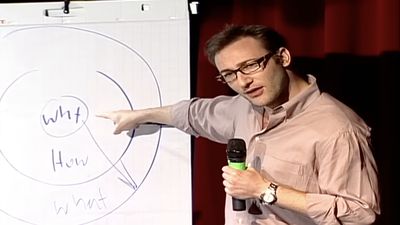
Simon argues that most organisations communicate and operate from the outside in. They start with what they do. They then move to how they do it. And, in most cases, they never actually get to the why at all.
However, he argues that the organisations that inspire loyalty, do the complete opposite! They start with why, and then move outwards to the how and the what.
Sinek’s most quoted observation from the model is probably the following line:
People don’t buy what you do, they buy why you do it. And, what you do, simply proves what you believe.
He uses Apple as an example of this. They don’t talk about how much RAM their latest iPhones have, they talk instead about why you need it! In their primary marketing materials, you don’t see performance benchmarks or read and write speeds. Instead, you see a father FaceTiming his daughter, being told he’s about to become a grandad. The reason why the phone has more RAM, is to be able to support the features that allow people to connect in real-time with their loved ones, and to share these special moments.
The reason this distinction is important, is because Sinek argues that facts, figures and data speak to your neocortex. The newest part of the human brain, that deals with language and logic. You can understand that a phone with more RAM is better, but you likely talk yourself out of buying it, because you don’t feel like you need it.
However, Apple marketing often speaks directly to your limbic system, the emotional processing part of your brain. This part evolved much earlier. It’s more instinctual, and therefore more difficult to override or reason with. You know logically you don’t really need a new iPhone, but something in you feels compelled to buy it, because you’ve emotionally invested in why you need it, rather than just how it’s better than the one you already have.
Anyway, you’re probably wondering what this has to do with accessibility. Well, although this whole idea is a marketing concept, it maps almost perfectly to why accessibility programmes so often fail.
Compliance without belief
Here’s what compliance without belief looks like in practice.
An organisation becomes aware of a deadline. For example, a new piece of legislation, like the European Accessibility Act. They pay for an external audit. They fix the failures. They publish an accessibility statement. They tick the box.
In this scenario, the organisation starts with what they need to do. For example, “we need to be WCAG 2.2 AA compliant”. They then move onto how they will do it. “We’ll pay for a third party audit and fix the failures”.
Then, they stop! Most organisations never go any further, and they never actually establish why they needed to do it in the first place. And, the why is the part that really matters. It’s where the people are, and the whole reason why we do user-centred design!
One or two releases later, and features are again shipping with low colour contrast and no keyboard support. Because nobody understood why it matters. They just fixed the things they were told to fix, and then they carried on exactly as before.
If this sounds like your organisation, then it’s likely you’ll end up with a process that none of your employees are emotionally invested in. No passion. No belief. Nobody really caring whether something is accessible or not. Everyone, just blissfully unaware of the people their work is failing to serve.
What the “why” actually looks like in practice
The why for accessibility is not complicated. It’s simply to build products that work for everybody. People love to talk about new features and what problems they’re going to solve. But, you never really hear them talking about the problems they’ve solved for their users with accessibility needs.
Roughly 1 in 5 people in the UK have a disability, according to figures from the Office for National Statistics. There are also many other people who might need accessibility features, as outlined in my post rising disability statistics.
Those statistics translate directly into people using your product. The people in the statistics aren’t just numbers, they are colleagues, family members, friends and customers. This is the why in practice. Not the monetary fine or compensation you need to pay out. Not the audit report full of issues. Not the reputational risk you carry, or the harsh user reviews. The why is the human being who cannot complete a task, because of a design choice your organisation made.
When people genuinely understand this and reframe their thinking, it’s far easier to have a different conversation. Instead of hearing discussions about the what you need to do, like “fix this failure of WCAG 1.1.1 Non-text Content”, you start hearing the why it needs to be done, like “this icon needs a text description, or it’s not going to work for a blind person.”
That shift, from focusing on compliance to focusing on people is a critical shift in culture. It’s a real step forwards in terms of accessibility maturity. When people are thinking like this, and you hear these kinds of conversations, this is when you know you’re on your way to doing sustainable accessibility in an organisation.
Building the “why” into your organisation
This post wasn’t intended to just be a philosophical point. There are practical things organisations can do to lead with purpose, rather than with regulation.
One of the most effective things you can do, is to be inclusive in your approach to design. Involve people with impairments as soon as possible, to fully understand who it is you’re designing for. If you can’t recruit the right people, or you don’t have the budget, at least use personas. You can use the GOVUK disabilities and impairments user profiles for free, and ask yourself, “how is this going to work for this person?”
When doing research or talking to users, don’t ask people what they want. This is still a common problem and the quickest way to bias your research. Instead, just observe them using the things you’ve built. As a developer, watching a screen reader user failing to navigate a product you built, is far more motivating than reading a technical report on why something fails a particular WCAG criterion. You get to see first-hand the friction, the frustration and the workarounds. It lands differently than any audit report, because the why is literally staring you right in the face!
From here, accessibility starts to feel less like a constraint and more like a design consideration. The same way performance, security, or browser compatibility are considered during development, you know why you do these things. You’ve likely had a frustrating experience with a slow website, or bad UX. Or, you’ve had your email address stolen in a hack, because somebody else’s website wasn’t secure. You understand this pain first hand, so you build things in to combat them as you go, and so that it scales! You don’t try and just bolt them on at the end, one sprint before you ship it! So, why approach accessibility differently?
Another important aspect of the why is leadership. If the people at the top of an organisation treat accessibility as just a risk to manage, so will everyone else. But, if they treat it as a core value, something the organisation believes in, then that filters down. This is Sinek’s point playing out in real-time. If your team doesn’t understand why you’re taking a new direction regarding accessibility, they are apathetic towards it at best. Or, they complain, moan and resist change which makes everything more difficult. If people understand and buy into a vision, then the culture change happens organically.
The difference between an organisation that consistently ships accessible features and one which does not, is not about budget, skills or compliance. It’s about empathy, respect and a deeper understanding of the people who use their products.
Compliance still matters
I want to be clear, I’m not arguing you don’t need to be compliant. It obviously matters! Standards set a measurable way to say if something has had the minimum amount of accessibility work needed, in order to be legal.
But, accessibility standards are a floor, not a ceiling. And, if your organisation treats compliance as the end goal rather than the minimum benchmark, you’ll likely spend your time chasing audit reports, whilst the experience and trust of your product quietly rots away at the edges due to poor user experiences.
So, the regulations tell you what you need to do. Your processes and tooling explain how you do it. But, until your organisation has a genuine, shared vision for why you’re doing it, which goes beyond just “because we have to”, you’re setting yourself up to fail.
Where to start
If you’re trying to shift the culture in your organisation, my honest advice is to stop leading with the law. Lead with the belief that your organisation treats people with respect, and that they won’t be excluded from using your product. Period. Show your organisation treats the what and the how as a physical expression of that belief.
If you’re struggling to think about how to define your why, start with your own experiences of something not working when you needed it to, or things you’ve experienced in your organisation. For example:
- your frustrations, like unresponsive interfaces or vague error messages
- the consequences of it not working, like deadlines or fines
- costs associated with that thing not working, like lost time or money
- potential alternatives or workarounds available to you, like competitors
Accessibility needs leaders within organisations who advocate for it. People who can articulate the why, and articulate it clearly enough so that others start to believe in it too! Because, a WCAG audit can only tell you if you’re doing the bare minimum, not whether an organisation is actually practising inclusive design.
I’ll leave you with the following quote. It’s how Sinek ends his TED talk, and I think it’s as relevant to accessibility as it is anything else:
We follow those who lead, not because we have to, but because we want to. We follow those who lead, not for them, but for ourselves. And it’s those who start with “why” that have the ability to inspire those around them, or find others who inspire them.
As always, thanks for reading.
Craig